Authors are told we need a social media presence. Publishers ask about it. Industry people ask about it. We all know we should probably be doing something.
But does any of it actually sell books?
That is the question. Not whether YouTube can get a view, a like, or a comment. The real question is whether it puts an author and their books in front of more readers in a meaningful way.
I have had seven-figure book deals, and one of the first questions in those publishing meetings is always about my social media profile. What do I have out there? How large is the audience? Yet nobody has ever been able to tell me precisely how much social media activity sells books.
YouTube is still my Achilles heel. I use it, but I have not built my entire author business around it. And honestly, I suspect a lot of authors are in the same position.
Key Takeaways
- YouTube can build author brand awareness even when direct book sales are difficult to measure.
- Connect Shorts to their related long-form videos to create a useful path into deeper content.
- Indie authors who control audiobook rights should consider YouTube as another listening platform.
- Authentic reader recommendations can outperform polished book advertising because they feel more trustworthy.
Table of Contents
- Start With the Real Goal: Brand Awareness
- What I Actually Do on YouTube
- Are Authors Creating Content for the Wrong Audience?
- Use Shorts to Send People to Long-Form Videos
- Audiobooks on YouTube: Rights Come First
- The Pirate Audiobook Problem
- Why Authentic Video Can Beat a Big Production
- Conversations Can Be Easier Than Presentations
- Use YouTube Collaborations for Author Interviews
- So, Does YouTube Sell Books?
Start With the Real Goal: Brand Awareness
I tend to look at my author career as a business. I sell books, which means I sell products. And when you run a business, one of the most important things you can build is brand awareness.
Someone might see my name in a magazine, a podcast, a short video, an article, or an interview. Then they may see it again a few weeks later somewhere else. Eventually, they walk down the book aisle at Walmart, spot one of my titles, and the name feels familiar.
They might not remember why it feels familiar. That is okay. Familiarity can make the difference between a book blending into the shelf and a book getting picked up.
That is the larger purpose behind much of what I do. I write for outlets such as Forbes, Rolling Stone, and Fast Company. If there is an opportunity to show up in a credible, high-profile place, I am interested. Not because I can draw a straight line from every appearance to a sale, but because repetition matters.
YouTube can fit into that same strategy. It may not be a magic book-selling machine, but it can be another place where the right people encounter your name, your work, and your personality.
What I Actually Do on YouTube
My core YouTube content comes from Writers, Ink, the weekly podcast I have been doing for years. We are nearing 400 episodes, and we have spoken with a long list of major authors.
The workflow is straightforward:
- We record each podcast episode as video.
- The full episode goes to YouTube once a week.
- Our producer creates a finished file for the channel.
- The episode is sent through OpusClip, which identifies potential short-form segments.
- I choose four or five clips I actually like.
- Those clips go out across YouTube Shorts, TikTok, Instagram Reels, and other video platforms.
That is pretty much the extent of it. Any time a video asset exists, I try to repurpose it for YouTube. But I have not made YouTube a separate content machine that requires hours of original production every week.
Time is the issue for most authors. We have a finite number of hours in a day, and most of them are already spoken for.
Automation Is Useful Until It Creates More Work
Tools such as OpusClip have gotten dramatically better. They can take a long interview and create 15 or 20 potential short clips, complete with captions and basic formatting. The software can even score clips according to which ones it believes are most likely to perform.
That is helpful, but it still needs a human involved. I look through the results, pick the strongest clips, and post them once. I do not want to flood every channel with clutter.
Social media is already becoming an incredibly noisy place. Automated systems create content. Automated systems react to content. At some point, it starts to feel like nobody needs to be involved at all.
I would rather select a few worthwhile clips, spread them out, and give people something new without repeating the same material endlessly. As a consumer, I find repetition irritating, so I try not to do it myself.
Are Authors Creating Content for the Wrong Audience?
Here is one of the bigger problems in author marketing: we often make content for other authors.
Writers, Ink is primarily geared toward writers. We talk to successful authors about how they started, how they built careers, and what happens behind the scenes. Fans of those authors often enjoy that material too, especially when we can pull back the curtain on somebody’s career. But the show is still fundamentally writer-focused.
The people we should be trying to reach are readers. They are the people browsing bookstores, listening to audiobooks, and buying novels.
That does not mean author-facing content has no value. It can build relationships, credibility, and community. But it is worth being honest about who the content is for and what that audience is likely to do next.
Before spending time on a new YouTube idea, ask one simple question:
Is this for fellow writers, for existing fans, or for potential readers?
The answer changes the format, the topic, the call to action, and the way success should be measured.
Use Shorts to Send People to Long-Form Videos
Shorts can be useful for discovery. They are easy to consume, easy to share, and they can introduce somebody to an author, guest, topic, or podcast episode.
But a Short does not automatically help the longer video it came from. That is where YouTube’s related video setting becomes valuable.
When editing a YouTube Short, you can manually attach a related video. If the Short comes from a longer podcast interview, attach that full interview. The Short then becomes a real doorway into the long-form content rather than a disconnected clip floating around on its own.
The workflow is manual, but simple:
- Open the Short in YouTube Studio.
- Choose the option to edit its related video.
- Select the full episode or long-form video the clip came from.
- Save the setting.
This is especially worthwhile when a Short gets traction. If one clip suddenly takes off, go back and make sure it is connected to the most relevant longer video. A popular clip can keep bringing new people into the channel long after it is posted.
Shorts Thumbnails Still Matter
It is tempting to think thumbnails do not matter for Shorts. They do.
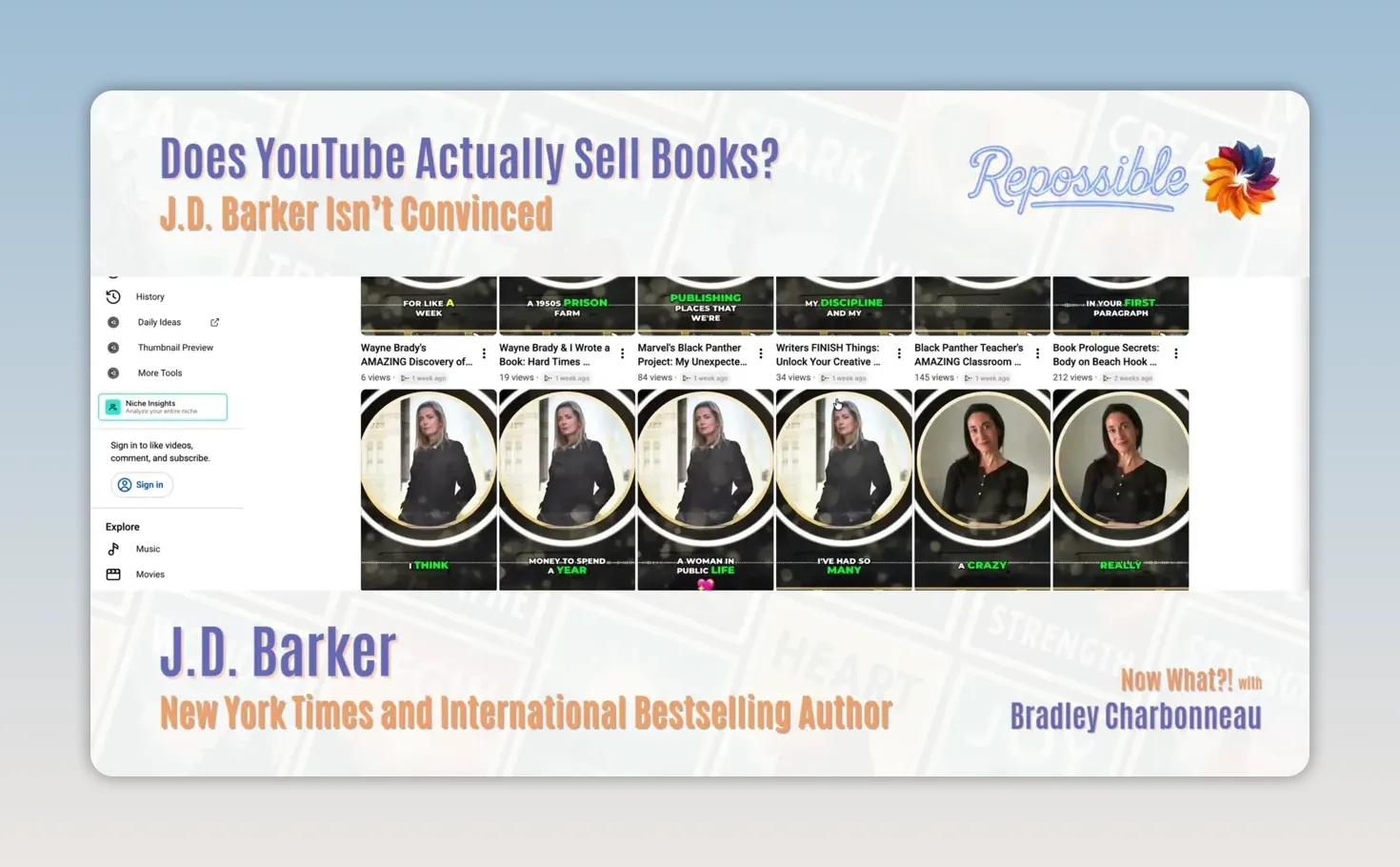
If a page is filled with four nearly identical images of the same guest, it is not immediately obvious what makes one clip different from another. The title text may eventually explain it, but people decide very quickly whether to tap something or keep moving.
This is no different from books. A book cover catches the eye first. Then the title. Then the description. Then perhaps a sample. Each stage asks for a slightly deeper commitment.
Video works the same way:
- Thumbnail: Is there a reason to stop?
- Title: Is this specific clip interesting?
- Opening seconds: Is it worth continuing?
- Related video: Is there a useful next step?
Automated clipping tools can help, but authors should still look at the final grid as a whole. If every thumbnail looks the same, a small manual change can make the channel easier to browse.
Audiobooks on YouTube: Rights Come First
Audiobooks are one of the most interesting opportunities on YouTube, but there is one enormous caveat: you must have the rights to upload them.
I self-published my first book and controlled that audiobook through ACX. But the books that came after that were traditionally published, and I eventually signed a deal with Recorded Books. They handle my audiobooks, which means I cannot simply upload those files wherever I want.
Rights control the strategy. Before using an audiobook on YouTube, an author needs to know exactly who owns the audio rights, what their distribution agreement allows, and whether an excerpt or full upload requires approval.
If You Control the Audiobook Rights, Consider the Full File
For indie authors who own their audiobook rights, putting audiobooks on YouTube can be a no-brainer.
Many people already use YouTube as an audiobook platform. They may pay for ad-free YouTube, and they may prefer that experience to signing up for Audible or using Spotify. They listen while driving, walking, running, cleaning, or doing whatever else takes up a normal day.
From the listener’s perspective, the ideal setup is often remarkably simple: one complete audiobook in one long file.
That may sound counterintuitive. A playlist divided into neat chapter-by-chapter videos seems more organized. But people generally do not want to stop every few minutes and choose another chapter. They want to press play and keep going.
The visual side does not need to become a movie either. A static book cover may be enough. Some light movement or relevant imagery can be nice, but it is probably not what the listener came for.
Trying to turn a novel into a homemade feature film risks competing with Netflix, and that is a competition most authors cannot win. The audiobook itself is the value. Double down on that.
Could Audiobook Excerpts Create a Funnel?
For authors or audiobook companies that do not want to release the entire book, excerpts may be worth exploring. A strong chapter, a five-minute section, or a short highlight could work as a teaser, followed by a clear link to the authorized audiobook retailer.
That can create a potential path:
- A short clip introduces the story or narrator.
- The clip leads to a longer excerpt.
- The longer excerpt sends people to the authorized audiobook edition.
Whether that makes sense depends on the rights holder, the title, and the company’s broader strategy. But it is a conversation worth having, particularly when audiobooks are already showing up in YouTube search results.
The Pirate Audiobook Problem
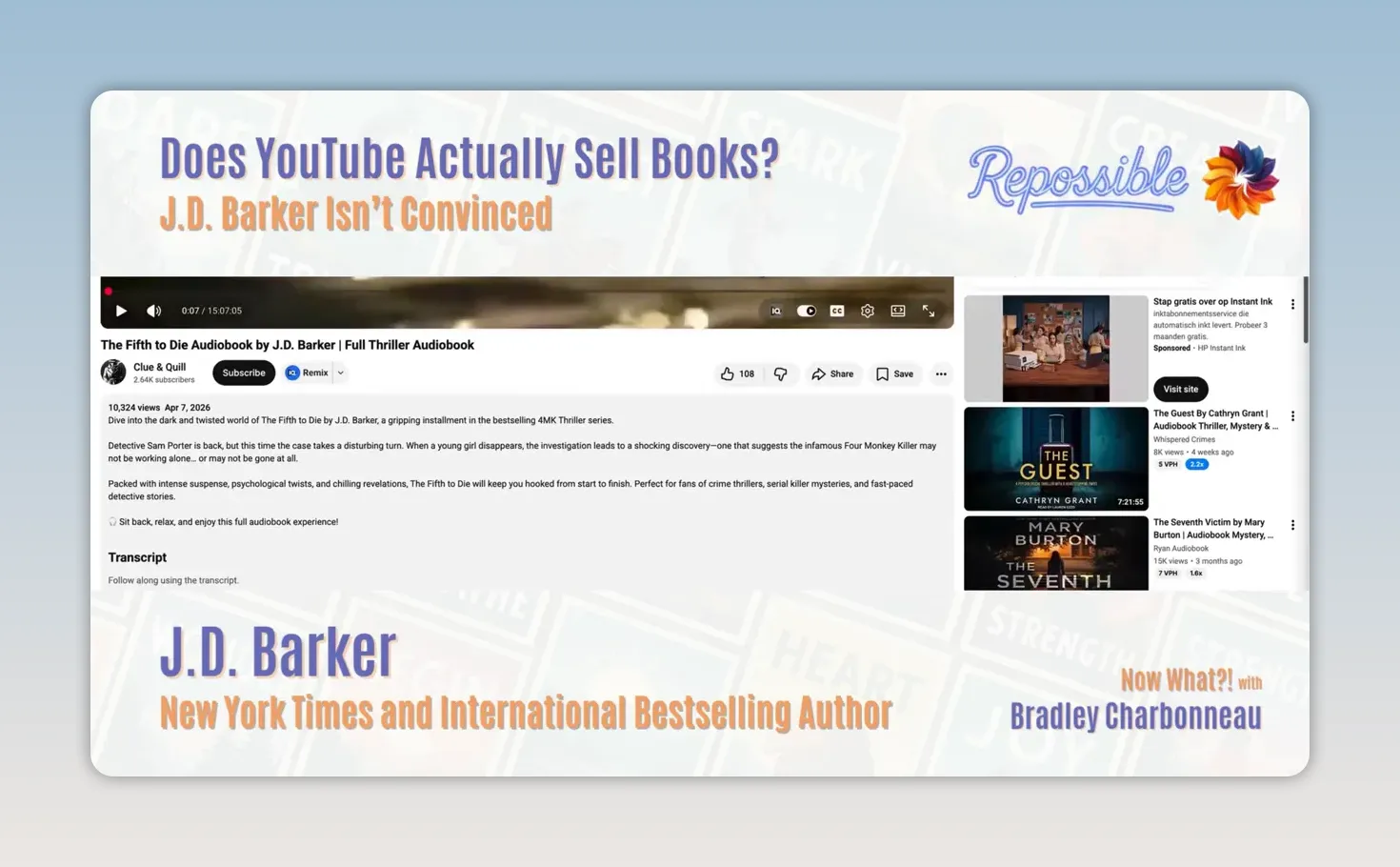
Searching YouTube for an author’s audiobooks can reveal an uncomfortable reality: somebody may have already uploaded them.
During our search, unauthorized copies of my books appeared in the results, including a 15-hour upload with more than 10,000 views. Other channels had posted additional titles and were receiving thousands of views on relatively recent uploads.
That is not a reason to ignore rights or violate a licensing agreement. If a company has legitimately licensed an audiobook, the author should not upload it independently just because a pirate channel did it first.
But it is a reason to notify the rights holder. Somebody should determine whether the upload is licensed, promotional, unauthorized, or in need of a takedown notice.
There is a complicated emotional side to piracy. People accessing a pirated audiobook may not have bought it otherwise, and unauthorized exposure can still introduce an author to new readers. But that does not make the upload legitimate, and it does not eliminate the need for the proper rights holder to handle it.
If you are an indie author with full audiobook rights, the equation is much simpler. YouTube is a place where people already listen to audiobooks. If you can legally put your work there, it is another market you can populate for free.
Why Authentic Video Can Beat a Big Production
I have produced television commercials for books, and I have learned a lot from writing with James Patterson. Traditional book advertising is not always the obvious path, and television is one area where relatively few authors compete.
But the biggest surprise was not an expensive commercial.
I took a simple TikTok review from an influencer who liked one of my books. We placed her video in the center of the screen, blurred the edges, kept her channel visible, and ran it as a 30-second spot.
It performed better than the heavily produced commercials.
That makes sense. A person holding up a book and explaining why they enjoyed it feels real. It does not look like a studio trying to imitate a Hollywood trailer. It feels like a recommendation from a human being.
Traditional book trailers can have the opposite effect when they are underfunded. People mentally compare them to movie trailers. If the production cannot meet that expectation, the book can seem smaller than it is.
In a world filling up with polished AI-generated content, imperfection may be an advantage. A phone video, a dog wandering through the frame, slightly imperfect audio, or somebody speaking naturally can signal that there is a real person on the other side of the screen.
We have been conditioned to accept this format. News channels use phone footage. People broadcast from events on a selfie stick. The rougher, more immediate style no longer automatically reads as low quality. Sometimes it reads as authentic.
Conversations Can Be Easier Than Presentations
There is another reason podcasting and interviews can work well for authors: they are often easier than creating a formal presentation.
I started Writers, Ink for a personal reason. I am autistic, and I have Asperger syndrome. When I first began receiving attention as an author, I hated being on camera and talking to people. Rather than hiding in my office, I decided to force myself to do it regularly.
A weekly podcast created a structure. I had to show up, talk, listen, and get more comfortable. Over time, it helped me come out of my shell.
For many authors, a conversation is much more approachable than being asked to create a polished 20-minute presentation, write a script, build slides, and deliver it alone to a camera.
You do not necessarily need a studio, a huge plan, or a PowerPoint deck. You can invite somebody interesting onto Zoom and have a real conversation about something you already know.
That is a perfectly legitimate YouTube format, and it can be much more sustainable than trying to become a full-time content creator on top of writing books.
Use YouTube Collaborations for Author Interviews
YouTube’s collaboration feature is another useful option for author interviews and joint projects.
When one channel publishes a collaboration video and invites the other participant, the content can appear as a collaboration on both channels. Both people can benefit from the views and traffic, and if both channels are monetized, the feature can benefit both sides without splitting the revenue.
For author interviews, this is about as close to a win-win as it gets. If you interview another author who has a YouTube presence, invite them to collaborate on the video. Their audience can discover it through their channel, and yours can discover theirs through yours.
The same idea can apply to Shorts. A short clip featuring an author, reviewer, narrator, or collaborator can potentially reach both communities.
So, Does YouTube Sell Books?
The honest answer is still: nobody really knows in a clean, universal way.
Some authors earn direct revenue from YouTube. Some put audiobooks there and build substantial listening audiences. Some use it as a podcast archive. Some use Shorts for visibility. Some do nothing with it at all.
The better question may be this: What role can YouTube play in your particular author business?
Maybe it is brand awareness. Maybe it is a channel for full audiobooks. Maybe it is short clips that introduce readers to your world. Maybe it is a recurring conversation series. Maybe it is authentic reader reviews used as advertising. Maybe it is simply another place where your name appears enough times to become familiar.
But start with the audience. Are you trying to reach writers, readers, existing fans, audiobook listeners, or industry contacts? Know that first.
Then pick the simplest format you can sustain. Do not create a giant process that steals time from the actual books. Try something. If it works, double down. If it does not, move on.
YouTube keeps changing. New features arrive, old assumptions disappear, and the platform never really sits still. That is frustrating, but it also means there are still opportunities for authors willing to experiment thoughtfully.
For more about my books, podcasts, and projects, visit my official website or explore the J.D. Barker YouTube channel.


